 BCBA-48%Bestseller
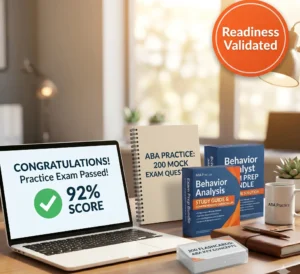
BCBA 6th Edition Exam Prep Bundle
- Visual study guide for the 6th Edition task list
- Active-recall flashcards
- 200-question timed mock exam with rationales
$76$147
View & buy →
Everything you need for BCBA exam prep in one place — a visual study guide, active-recall flashcards and a full timed BCBA practice exam with detailed rationales. Built to show you exactly what to study next so you walk into the BCBA exam ready.
Your BCBA prep is organised around the core task-list domains — so every study guide page and practice question maps to something you will actually be tested on.
The BCBA exam is not a vocabulary test. Most questions build a short case around a client and ask you to apply a principle correctly to the specific details in that stem, not just recognize a definition.
Verbal behavior questions, for example, expect you to tell a mand from a tact from an intraverbal based on what controls the response — an item that looks like a tact because a picture is present can still be a mand if the underlying motivating operation is what's actually evoking it. Measurement questions expect you to pick the right IOA calculation method (exact count-per-interval, trial-by-trial, or block-by-block) based on how the data were actually recorded, not just recall that IOA exists. Experimental-design items usually describe a graph in words — a return to baseline, a staggered introduction across three behaviors, an alternating pattern of two conditions — and ask you to name the design and its logic, which means you need to be able to visualize a graph from a paragraph.
Ethics and supervision items work the same way: they present a workplace situation — a supervisee asking you to sign off on hours you didn't observe, a caregiver requesting a service outside your competence — and ask what the responsible next step is, not what the rule says in the abstract.
A typical stem: a child engages in self-injurious behavior that increases specifically during transitions between preferred and non-preferred activities, and only when a demand has just been delivered. The question asks which function is most likely supported by that pattern, or which intervention — differential reinforcement of alternative behavior, functional communication training, non-contingent reinforcement — best matches an escape-maintained behavior versus one maintained by access to tangibles. Every answer option is behavior-analytically plausible in isolation; the distractors are usually correct principles applied to the wrong function. That's what makes these items harder than they look on a first read — you're choosing between four real interventions and identifying the one that fits the function described in the stem.
There's one best answer per item, and the reasoning has to be tied to the specific detail in the case — general familiarity with a concept gets you close, but the correct answer usually hinges on one qualifying phrase in the scenario (only during transitions, only after a demand, only when alone).
The most common error is treating similar concepts as interchangeable under time pressure — negative reinforcement and punishment, extinction burst and spontaneous recovery, response blocking and physical guidance. These get missed less from not knowing the definitions and more from not having drilled the side-by-side distinction until it's automatic.
The second is skipping graph literacy. If you can define a multiple-baseline design but can't identify one from a described data pattern, you'll miss design questions regardless of how well you know the term. The third is under-practicing ethics and supervision scenarios specifically, since they're graded on judgment rather than recall and don't respond well to last-minute cramming — they need the same repeated scenario practice as the clinical content.
Instant digital access. Lifetime updates. Secure PayPal & card checkout.
BCBA-48%BestsellerStart free, then get the full BCBA bundle when you are ready.
Preparing for more than one exam, or not sure which credential fits? Explore every path we cover.
ABA Practice provides independent, unofficial study materials and practice questions. We are not affiliated with, endorsed by, or sponsored by any certification board or credentialing organization. Practice questions are original and written for study purposes only; they are not real exam items. Prices shown in USD.