 QASP-S-37%Bestseller
QASP-S Exam Prep Bundle
- Visual study guide
- 200 active-recall flashcards
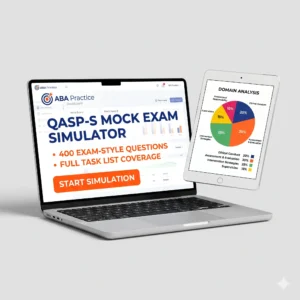
- Two timed mock exams, 400 questions
$67$107
View & buy →
Focused QASP-S exam prep for autism-services practitioners — a visual study guide plus 400 QASP-S practice exam questions across two timed simulations with rationales. Prep in English or العربية.
Your QASP-S prep is organised around the core task-list domains — so every study guide page and practice question maps to something you will actually be tested on.
QASP-S content sits one level above direct implementation — most items put you in the role of the person deciding whether a program is working, not the person running it session to session.
Skill-acquisition and behavior-reduction questions describe a program that's already in place and ask you to read the outcome: is a flat trend after several weeks a prompting problem, a reinforcer that's lost potency, or a target set at the wrong difficulty level, and what should change first. Data-and-analysis items test the same skill from the graph side — reading trend, level, and variability across phases and deciding what the pattern actually supports, rather than just naming the design. Assessment items are similarly supervisory: less about running the assessment yourself and more about reviewing one a technician conducted and deciding whether it was done correctly and what it means for the plan.
Supervision-and-ethics content covers the specific responsibilities of overseeing frontline staff delivering autism services — checking treatment fidelity, catching drift from the written plan before it becomes a pattern, and knowing when a modification needs sign-off versus when a technician can make a minor adjustment on their own.
A typical stem: a technician's data sheet shows a skill-acquisition target has been flat for three consecutive weeks despite consistent sessions. The question asks what you, as the supervisor, should do next — and the answer set usually includes options like increasing session frequency, changing the reinforcer, checking for prompt dependency, or re-assessing whether the target is still appropriate. The correct choice depends on ruling out the most likely cause first (prompt dependency and reinforcer potency are the two most commonly tested culprits) rather than jumping straight to redesigning the whole program.
Fidelity-monitoring stems work similarly — you're given a brief description of how a technician ran a session and asked to spot where it drifted from the written procedure, which tests observational precision as much as knowledge of the procedure itself.
Candidates who've mostly worked in a direct-implementation role tend to answer from that mindset — picking "report it to someone else" when the item is actually asking them to be the one who makes the call. The second common miss is treating data-analysis items as pure math instead of pattern-reading; these questions rarely ask you to calculate anything, they ask you to interpret a described trend. Practicing with graph-reading scenarios specifically, not just definitions of trend and variability, closes this gap fastest.
Instant digital access. Lifetime updates. Secure PayPal & card checkout.
QASP-S-37%Bestseller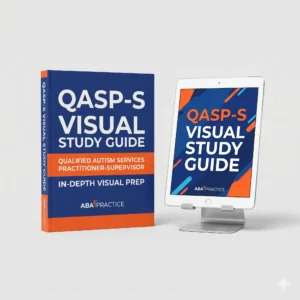 QASP-S-45%
 QASP-S-39%
 QASP-S · AR-47%
Start free, then get the full QASP-S bundle when you are ready.
Preparing for more than one exam, or not sure which credential fits? Explore every path we cover.
ABA Practice provides independent, unofficial study materials and practice questions. We are not affiliated with, endorsed by, or sponsored by any certification board or credentialing organization. Practice questions are original and written for study purposes only; they are not real exam items. Prices shown in USD.