 RBT-20%Bestseller
RBT Study Guide & Mock Exam Bundle (3rd Edition)
- 3rd Edition task-list study guide
- Mock exam with detailed rationales
- Scenario-based practice questions
$57$71
View & buy →
Fast, focused RBT exam prep aligned to the 3rd Edition task list — a study guide plus a realistic RBT practice exam with rationales. Take an RBT practice test, see your weak spots, and pass with confidence.
Your RBT prep is organised around the core task-list domains — so every study guide page and practice question maps to something you will actually be tested on.
The RBT exam is built around one question: given a written behavior plan, do you know what to do right now, in the room, without redesigning anything.
Most items describe a moment inside a session — a child refuses to transition, a learner emits a target response during a discrete trial, a caregiver asks a question mid-session — and ask you to pick the correct next action based on procedures a supervisor already wrote, not to design a new one. Skill-acquisition questions test whether you can run a trial correctly and choose the right prompting level (most-to-least, least-to-most, or graduated guidance) for what the stem describes, and whether you fade the prompt at the right moment rather than too early or too late. Measurement questions test whether you pick the correct recording method for the behavior described — duration for a tantrum, rate for a discrete response with variable opportunity, ABC narrative when the function isn't yet known — since choosing the wrong measurement type is one of the most common ways technicians produce unusable data.
A typical stem: mid-session, a client begins hitting when asked to put away a preferred item, and the written plan calls for planned ignoring plus redirection to a replacement response. The question asks what you do — and the correct answer follows the plan exactly and documents what happened, rather than switching to a different consequence that also sounds reasonable. Distractors are usually built from real strategies that would work for a different behavior plan or a different function; picking one means you understand behavior reduction in general but not implementation fidelity, which is specifically what this exam checks.
The exam also tests judgment about escalation — when a situation is outside what the plan covers (a new behavior, a safety concern, a caregiver request to change the program), the correct answer is almost always to stop and report up, not to improvise a clinical decision.
The single biggest mistake is answering from a supervisor's scope instead of a technician's — picking the option that changes or adjusts the intervention when the correct answer is to follow the plan as written and flag the issue. The second is mixing up the order of a prompting hierarchy under time pressure. The third is documentation language — confusing objective, observable descriptions of behavior with interpretive language that sounds professional but wouldn't hold up as usable data.
The fastest fix for all three is practicing with full scenarios rather than isolated definitions: read the whole stem, identify what role you're being asked to play in it, and only then look at the answer choices.
Instant digital access. Lifetime updates. Secure PayPal & card checkout.
RBT-20%Bestseller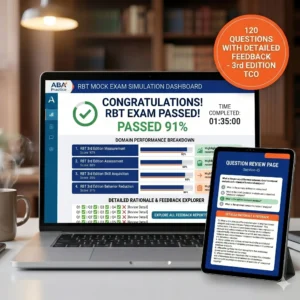 RBT-43%
Start free, then get the full RBT bundle when you are ready.
Preparing for more than one exam, or not sure which credential fits? Explore every path we cover.
ABA Practice provides independent, unofficial study materials and practice questions. We are not affiliated with, endorsed by, or sponsored by any certification board or credentialing organization. Practice questions are original and written for study purposes only; they are not real exam items. Prices shown in USD.