
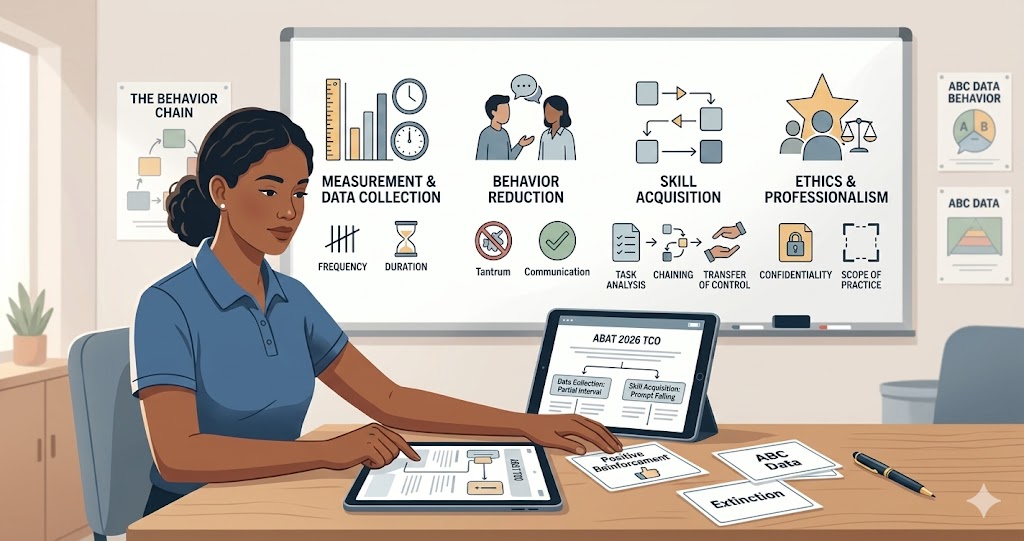
ABAT vs RBT — both are entry-level ABA credentials for
behavior technicians, but they are issued by different credentialing boards,
require different supervision structures, and carry different international
recognition. ABAT is issued by QABA Board; RBT is issued by BACB.
This guide compares both credentials side by side so you can make the right
decision for your career in 2026.
Not sure which exam to prepare for first?
Try a free ABA practice exam
— no account required — and assess your current knowledge level.
ABAT vs RBT: Quick Overview
| Criterion | ABAT (QABA Board) | RBT (BACB) |
|---|---|---|
| Issuing Body | QABA Board (ANAB-accredited) | BACB (Behavior Analyst Certification Board) |
| Minimum Age | 18 years old | 18 years old |
| Education | High school diploma or equivalent | High school diploma or equivalent |
| Training Hours | 40 hours: ABA principles + 3 hrs ethics + 5 hrs autism core knowledge | 40-hour RBT Training (BACB Task List) |
| Competency Assessment | Not required | Required — RBT Competency Assessment by a BCBA/BCaBA |
| Supervised Fieldwork | 15 hours minimum before exam | Not required before exam — ongoing 5% monthly supervision after certification |
| Exam Platform | Online — Examity remote proctoring | Pearson VUE — in-person testing center |
| Exam Fee | $125 (application + first attempt) | $45 (application) + $45 (exam) = $90 total |
| Passing Score | 72% | Scaled score — approximately 68% correct |
| Exam Questions | 125 MCQ (100 scored + 25 unscored) | 85 MCQ (75 scored + 10 unscored) |
| Renewal Cycle | Every 2 years — 12 CEUs (3 live + 1 ethics minimum) | Annually — RBT Competency Assessment renewal + supervision |
| Supervisor Type | QASP-S, QBA, or master’s-level licensed/credentialed professional | BCBA or BCaBA only |
| Ongoing Supervision | 5% of direct hours every 90 days | 5% of direct hours monthly |
| International Recognition | Strong — widely accepted outside North America | Primary recognition: North America and U.S.-affiliated settings |
| Background Check | Required — SecureTrac or employer attestation | Required — BACB criminal background check |
ABAT: What You Need to Know
ABAT is issued by QABA Board (Qualified Applied Behavior Analysis
Credentialing Board), an ANAB-accredited credentialing organization.
It is the entry-level tier in QABA’s three-credential model:
ABAT → QASP-S → QBA.
Who ABAT Is Best For
- Candidates working or planning to work outside North America
- Technicians supervised by a QBA or QASP-S (not necessarily a BCBA)
- Candidates who prefer online remote proctoring over in-person testing centers
- Technicians who plan to advance to QBA without transitioning to the BACB pathway
ABAT Exam at a Glance
- 125 MCQ — 100 scored, 25 unscored (not labeled)
- 2 hours — online via Examity
- Passing score: 72%
- Fee: $125
- Max 4 attempts per calendar year
Prepare for the ABAT exam with verified
ABAT practice questions and mock exams
aligned to all 7 official QABA content domains.
RBT: What You Need to Know
RBT (Registered Behavior Technician) is issued by BACB (Behavior Analyst
Certification Board). It is the most widely recognized entry-level ABA
technician credential in the United States and Canada. RBT operates under
direct BCBA or BCaBA supervision.
Who RBT Is Best For
- Candidates working in U.S. or Canadian ABA clinics, schools, or insurance-funded settings
- Technicians supervised directly by a BCBA or BCaBA
- Candidates who prefer in-person Pearson VUE testing centers
- Technicians planning to advance to BCaBA or BCBA on the BACB pathway
RBT Exam at a Glance
- 85 MCQ — 75 scored, 10 unscored (not labeled)
- 90 minutes — Pearson VUE testing center
- Scaled score (approx. 68% correct to pass)
- Fee: $45 application + $45 exam = $90
- Annual renewal — RBT Competency Assessment required
Key Differences That Matter Most
1. Supervisor Flexibility
ABAT allows supervision by any QASP-S, QBA, or master’s-level licensed
professional within the scope of ABA and autism. RBT restricts supervision
to BCBA or BCaBA only. If your employer or setting does not have a BCBA on
staff, ABAT offers broader flexibility.
2. International Portability
Outside North America — particularly in the Middle East, Europe, and
Southeast Asia — QABA credentials including ABAT are widely accepted in
settings where BACB recognition is limited. If your career is internationally
focused, ABAT carries a clear advantage.
3. Renewal Burden
RBT renewal is annual and requires a full RBT Competency Assessment each
cycle. ABAT renewal is every two years and requires 12 CEUs. For candidates
managing busy clinical schedules, the biennial ABAT renewal cycle is
significantly less burdensome.
4. Exam Access
ABAT is delivered online via Examity — you test from home with a webcam and
stable internet. RBT requires an in-person Pearson VUE testing center, which
may not be accessible in all regions. For candidates in areas without nearby
Pearson VUE centers, ABAT is the practical choice.
5. Career Pathway
ABAT leads to QASP-S then QBA within the QABA pathway. RBT leads to BCaBA
then BCBA within the BACB pathway. Both pathways are independent — choose
the one aligned to where you plan to practice and with whom you will be
supervised.
5 Tips to Choose the Right Credential for Your Situation
-
Check your supervisor’s credentials first.
If your employer has a BCBA on staff, RBT is straightforward.
If your supervisor holds a QBA, QASP-S, or equivalent master’s-level license,
go with ABAT. The wrong choice forces you to find a new supervisor. -
Check your country’s insurance and licensing requirements.
In the U.S., many insurance providers require RBT for billing ABA services.
Outside North America, QABA credentials are often preferred or the only
recognized option. -
Consider your long-term career goal before your first credential.
Planning to become a BCBA? Start with RBT.
Planning to become a QBA? Start with ABAT.
Switching pathways mid-career is possible but requires starting fresh on the
new pathway’s requirements. -
Factor in exam access.
No Pearson VUE center nearby? ABAT’s online remote proctoring removes
that barrier entirely. -
Consider renewal reality.
Annual RBT renewal with a competency assessment every year is a real
time and cost commitment. If stability matters, ABAT’s 2-year cycle is
easier to manage.
Browse the full ABA exam prep collection
— ABAT, RBT, QBA, QASP-S, IBA, and BCBA preparation bundles.
Frequently Asked Questions
Is ABAT harder than RBT?
ABAT has more questions (125 vs 85), a longer exam (2 hours vs 90 minutes),
and covers 7 content domains including deeper autism core knowledge and ethics
content. Most candidates report similar difficulty, but ABAT requires more
preparation time due to its broader scope.
Is ABAT accepted in the United States?
Yes. ABAT is a nationally recognized credential in the U.S. However,
insurance billing in many U.S. states specifically requires RBT under BACB
supervision. Verify your state and employer requirements before choosing.
Can I hold both ABAT and RBT?
Yes. Holding both credentials is permitted and some candidates pursue both
to maximize employer flexibility. There is no rule preventing dual
credentialing.
Which credential is cheaper — ABAT or RBT?
RBT costs $90 for application and first exam attempt. ABAT costs $125.
However, RBT annual renewal with competency assessments adds up over time,
while ABAT’s biennial renewal at lower CEU requirements can be more
cost-effective long-term.
Which exam has a higher pass rate — ABAT or RBT?
Neither QABA nor BACB publicly releases official first-attempt pass rates
for their entry-level exams. The best predictor of passing on the first
attempt for both credentials is consistent full-length timed mock exam
practice above 80%.
Does ABAT require a competency assessment?
No. ABAT does not require a formal competency assessment before sitting for
the exam. RBT requires a formal RBT Competency Assessment conducted by a
BCBA or BCaBA before the candidate is eligible to test.
Sources
-
QABA Board — ABAT® Scope of Practice:
qababoard.com/abat-scope
-
QABA Board — How Our Exams Work:
qababoard.com/taking-examinations
-
BACB — RBT Certification Requirements:
bacb.com/rbt
-
BACB — RBT Handbook:
bacb.com — RBT Handbook
-
QABA Board — Official Registry:
qababoard.com
Disclaimer: Credential requirements, fees, and renewal
standards are subject to change without notice. Always verify current
requirements at
qababoard.com
and
bacb.com
before making certification decisions.