The BCBA first-time pass rate just hit 51%. Not 51% fail. 51% pass. That means roughly half the people who sit for the biggest behavior analyst certification exam in the field walk out without a credential, and most of them genuinely believed they were ready.
RBT candidates do better at around 74-80%, but that still leaves 1 in 4 paying a retake fee they didn’t plan for. QBA, QASP-S, and ABAT don’t publish pass rates, but the retake fees ($225 for QBA, $175 for QASP-S, $50 for ABAT) tell you QABA expects a lot of candidates to need a second shot.
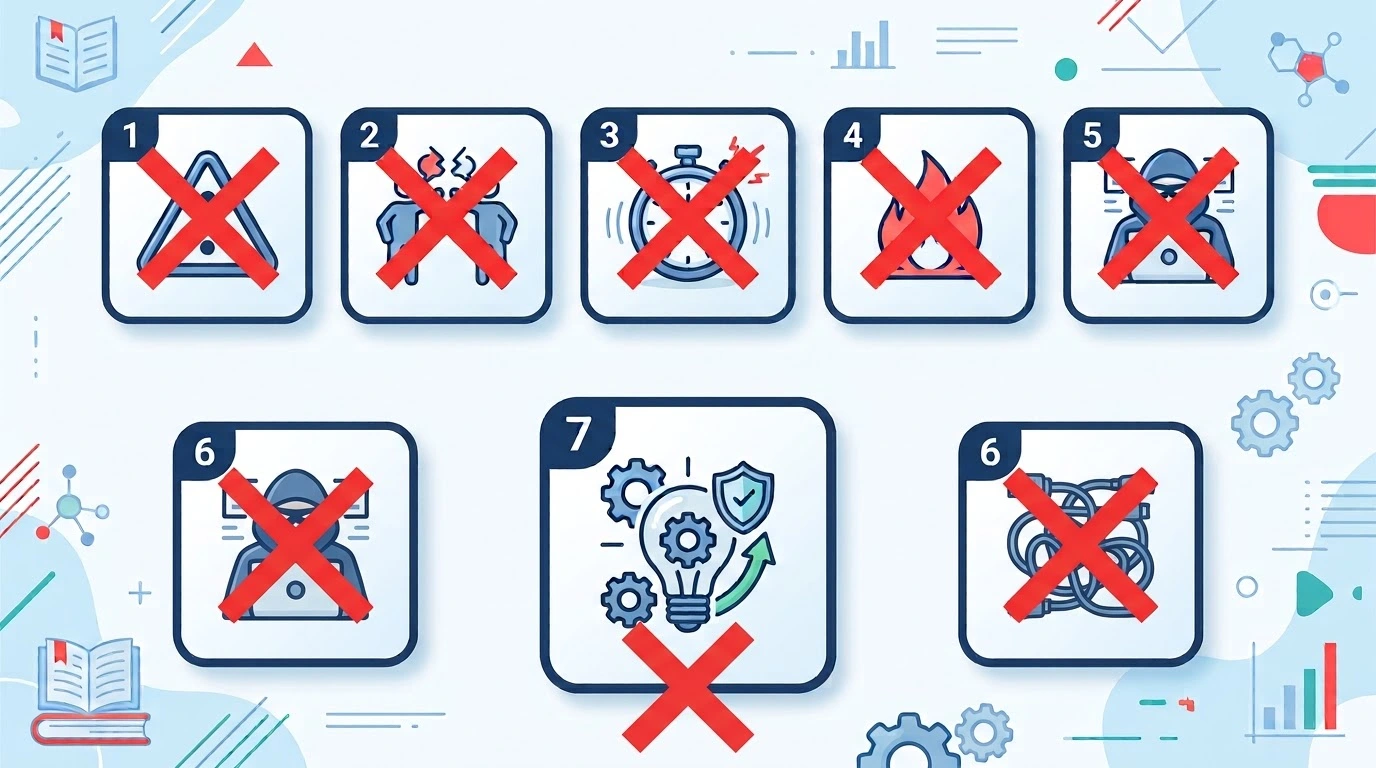
Here’s the thing: most failures aren’t about intelligence. They’re about pattern. The same seven mistakes show up across every ABA credential, from entry-level ABAT to graduate-level BCBA. Fix them before exam day and the odds shift hard in your favor. Want to see where you actually stand right now? The free ABA practice exam takes 15 minutes and tells you more than another week of passive reading.
⚠️ Important: Every retake costs real money, and the cost compounds fast. A single BCBA retake runs $265 ($140 application + $125 Pearson VUE). A QBA retake is $225. Even ABAT, the cheapest option, costs $50 per attempt. Two or three retakes and you’ve spent more on failed attempts than a proper prep bundle would have cost upfront.
✅ Prepping for BCBA or RBT (BACB credentials): The BCBA Bundle ($76) and RBT Mock Exam are built around the current test content outlines — not outdated task lists.
🌍 Prepping for QBA, QASP-S, or ABAT (QABA credentials): The QBA Bundle ($67), QASP-S Bundle ($67), and ABAT Bundle ($57) each include timed mock exams and answer explanations matched to the current QABA blueprints.
What a Failed Behavior Analyst Certification Exam Actually Costs You
Before we get into the mistakes themselves, look at what a single retake costs across every credential. This table alone usually changes how seriously people take their first attempt.
| Credential | First Attempt Cost | Each Retake | Max Attempts | Prep Bundle |
|---|---|---|---|---|
| BCBA | $370 | $265 | 8 in 2 years | $76 |
| RBT | $110 | $45 | 8 in 1 year | See price |
| QBA | $350 | $225 | 4 in 1 year | $67 |
| QASP-S | $300 | $175 | 4 in 1 year | $67 |
| ABAT | $125 | $50 | 4 in 1 year | $57 |
A single QBA retake ($225) costs more than three times the price of the entire QBA prep bundle ($67). That ratio is similar across every credential. The prep isn’t the expense. The retake is.
Mistake #1: Studying Definitions Instead of Applied Scenarios
This is the single most common reason candidates fail any behavior analyst certification exam, and it looks the same across every board. A candidate reads a textbook, memorizes definitions of reinforcement, extinction, and stimulus control, and walks into the exam feeling confident. Then the first question describes a clinical scenario with three plausible answers and asks which intervention is most appropriate given a specific function of behavior. Definitions don’t answer that.
The BCBA exam runs entirely on applied scenarios built around the 6th edition Test Content Outline. The QBA and QASP-S exams lean heavily on clinical decision-making across 100 scored questions each. Even the ABAT exam, which is technically entry-level, uses scenario-based questions where you need to identify the correct technician response, not recite a glossary term.
The fix is straightforward: study with timed practice questions that mirror the actual exam format. If your prep doesn’t put you in front of a scenario and force you to pick an answer under time pressure, it’s not exam prep. It’s reading. Reading is step one. Exam prep is step two, and most people skip it entirely.
Mistake #2: Treating All Exam Domains Equally
Every ABA certification exam weights its domains unevenly. Candidates who split their study time equally across all sections are over-investing in low-weight areas and under-investing in the ones that actually determine their score.
BCBA candidates lose the most here. Ethics and behavior-change procedures carry outsized weight on the 6th edition outline, but many candidates spend the bulk of their time on measurement and experimental design because those feel more “concrete.” RBT candidates face a similar trap: Behavior Acquisition alone accounts for roughly 25% of scored questions on the 3rd edition outline, but candidates who studied under the old task list don’t realize the weighting shifted.
For QBA and QASP-S, the pattern holds. Our breakdown of QBA exam difficulty by domain shows that ethical practice and behavior-change procedures are the two areas where candidates lose the most points, not measurement or data collection.
Before you build a study schedule, look at the actual exam blueprint for your credential. Then weight your study time to match. Don’t guess. Don’t spread it evenly. Match the blueprint.
Mistake #3: Ignoring the Ethics Section Until the Last Week
Ethics is never the fun part of exam prep. It feels like common sense until you’re staring at a question where two options both seem ethical and you have 90 seconds to decide which one the board considers correct.
BCBA candidates are tested on the BACB Ethics Code for Behavior Analysts, and ethics questions make up a significant share of the total exam. RBT candidates are tested on the separate RBT Ethics Code 2.0, which has 29 standards that overlap with the BCBA code in some areas and diverge sharply in others. Confusing the two is another common mistake.
QBA and QASP-S candidates face the QABA Code of Ethical and Professional Conduct, which has its own structure, its own vocabulary, and its own enforcement process through the QABA Ethics Committee. If you’ve read the BACB code and assume QABA’s works the same way, you’ll answer ethics questions from the wrong framework. We covered exactly this problem in our QBA ethics questions guide, which walks through the hardest scenario types with full answer explanations.
Start ethics early. Study it in parallel with every other domain, not crammed into the last 72 hours before your exam.
Mistake #4: Not Simulating Real Exam Conditions
There’s a gap between knowing the material and performing under test conditions that catches people off guard every time. The BCBA exam is 4 hours. QBA and QASP-S are each 3 hours. RBT is 90 minutes. ABAT is 2 hours. None of these are sprint exams. They’re endurance tests, and the candidates who practiced with untimed flashcard decks find that out the hard way.
Pacing matters more than most candidates realize. On the QBA exam, 125 questions in 3 hours gives you about 1 minute 26 seconds per question. That sounds comfortable until you hit a scenario question with a long stem and four answer choices that all look partially right. Candidates who’ve never practiced under a clock lose 5-10 minutes on a single difficult question and then rush through the last 20.
Sit down with a timed mock exam at least twice before test day. Once to diagnose your weak domains. Once more, after targeted study, to confirm the fix worked. The free practice exam is a fast diagnostic. The full bundles give you the timed simulation.
Mistake #5: Using Outdated Study Materials
This mistake has gotten worse in 2026 because multiple credentials updated their exam outlines recently, and many prep materials on the market haven’t caught up.
The BCBA exam moved to the 6th edition Test Content Outline in January 2025. Any study guide still organized around the 5th edition is teaching you content that no longer matches the exam blueprint. The RBT exam switched to the 3rd edition Test Content Outline in January 2026, replacing the 2nd edition Task List that had been in use since 2018. Four of six domain names changed. The question weighting shifted. If your prep materials still say “Skill Acquisition” instead of “Behavior Acquisition,” they’re out of date.
QABA credentials (QBA, QASP-S, ABAT) are more stable, but the 2026 fieldwork hours change for QBA (from 1,500 to 2,000 hours for new applicants after January 1, 2026) means older candidate handbooks show requirements that no longer apply. If you’re studying from a 2024 QBA handbook, your eligibility assumptions might be wrong even if the exam content hasn’t changed dramatically.
Check the publication date on every resource you use. If it predates the current exam outline for your credential, replace it.
Mistake #6: Skipping the Competency Assessment Prep (RBT and ABAT)
This one only applies to candidates pursuing RBT or ABAT, but it trips up a surprising number of people. Both credentials require a hands-on competency assessment before you can sit for the written exam, and candidates often treat it as a formality rather than a genuine evaluation.
The RBT Initial Competency Assessment covers 19 tasks, and as of 2026, three of those tasks must be demonstrated with an actual client. Your assessor is a BCBA or BCaBA who signs off on your readiness. If your demonstration is sloppy or if you can’t articulate why you’re implementing a procedure a certain way, the assessor can fail you, and you’ll need to reschedule and potentially pay again.
The ABAT competency assessment follows a similar model through QABA. Candidates who sailed through their 40-hour training sometimes stumble here because training teaches you the content while the competency assessment tests whether you can do it live, under observation, with a real client in front of you.
Practice the hands-on tasks with your supervisor before the formal assessment. Don’t walk in cold.
Mistake #7: Not Checking Eligibility Rules Before Starting Prep
This isn’t an exam performance mistake. It’s worse. It’s a mistake that makes the exam irrelevant entirely.
BCBA and RBT candidates outside the US and Canada face geographic restrictions that are tightening on a rolling basis. Ontario lost RBT and BCaBA eligibility in July 2024. The UK lost all BACB eligibility in January 2026. Australia loses it in January 2027. Candidates in these regions who spent months on BCBA or RBT exam prep discovered, sometimes after completing coursework, that they couldn’t submit an application.
QBA candidates hit a different version of this: the fieldwork hours requirement jumped from 1,500 to 2,000 for anyone starting after January 1, 2026. Candidates who built a timeline around 1,500 hours found themselves 500 hours short with no shortcut.
Before you buy a single study resource or log a single fieldwork hour, confirm three things: your country is eligible, the current hour and coursework requirements match your plan, and the exam outline you’re studying is the one that will be active on your test date. Our QBA vs BCBA vs IBA comparison lays out which credentials are available where, so you don’t invest time in a pathway that’s closed to you.
The Pattern Behind All Seven Mistakes
If you step back from the list, every mistake falls into one of two categories: studying the wrong thing, or studying the right thing the wrong way. Definitions instead of scenarios. Equal time instead of weighted time. Old outlines instead of current ones. Untimed reading instead of timed practice. These aren’t knowledge gaps. They’re strategy gaps. And a strategy gap is easier to fix than a content gap, because it only takes one adjustment to change the outcome.
Candidates who pass on their first attempt across every behavior analyst certification share a short list of habits: they study from the current exam blueprint, they weight their time by domain, they practice under timed conditions, and they start ethics early instead of late. None of that requires more hours. It requires different hours.
Stop guessing. Start with a diagnostic.
The free practice exam tells you which domains need work before you spend a dollar on prep. When you’re ready for the full timed simulation, pick the bundle that matches your credential: BCBA ($76), QBA ($67), QASP-S ($67), ABAT ($57), or RBT.
Frequently Asked Questions
Which ABA exam has the lowest first-time pass rate?
The BCBA exam, at 51% as of 2025. That’s the lowest it’s ever been. Retake pass rates are even lower, around 23%, which is why getting the first attempt right matters more than anything else.
Are these mistakes different for QABA exams versus BACB exams?
The pattern is the same across both boards: scenario-based questions, uneven domain weighting, and separate ethics codes all create the same traps. The specific outlines and codes differ, but the study mistakes are nearly identical.
How many times can I retake an ABA certification exam?
BCBA allows 8 attempts in 2 years. RBT allows 8 attempts in 1 year. QBA, QASP-S, and ABAT each allow up to 4 attempts within 1 year, with waiting periods between attempts that get longer after the second failure.
Is it better to study longer or to study smarter?
Smarter. Most failed candidates studied enough hours. They studied the wrong material, in the wrong proportions, without timed practice. Shifting to weighted, timed, scenario-based prep usually matters more than adding more weeks.
Do I need a different prep strategy for each certification?
The core strategy (weight by blueprint, practice under timed conditions, start ethics early) works across all of them. What changes is the specific exam outline, the ethics code, and the domain names. Make sure your study materials match the credential you’re actually sitting for.
Can I use BCBA study materials to prep for the QBA exam?
Partially. The underlying ABA content overlaps, but the exam blueprints, ethics codes, and credentialing boards are different. Using BCBA-only materials for a QBA exam will leave you underprepared on QABA-specific content and may teach you the wrong ethics framework.
What’s the single most effective thing I can do to avoid failing?
Take a full-length timed mock exam at least two weeks before your test date. It exposes your weak domains, your pacing problems, and your scenario-reading gaps in a single sitting. Everything else you study after that becomes targeted instead of random.
Where do I start if I don’t know which credential fits me?
Start with our QBA vs BCBA vs IBA comparison for graduate-level credentials, or the ABAT vs RBT comparison for entry-level. Both cover eligibility, cost, and international recognition so you pick the right path before you start prepping for the wrong exam.
Disclaimer: ABA Practice is an independent exam-prep resource and is not affiliated with, endorsed by, or acting on behalf of the Behavior Analyst Certification Board (BACB), QABA, or IBAO. Certification requirements, fees, pass rates, and eligibility rules change; always confirm current details directly with the relevant board before applying.
Sources: