
Thirty days is enough time to cover all 43 tasks on the RBT exam outline. It isn’t enough to cover them equally, and that’s where most people’s RBT study plan goes wrong. This RBT study plan puts your hours where the points are. Before Day 1, take the free ABA practice exam so you know your real starting point.
One rule first. The BACB currently accepts RBT applications only from residents of the United States, Canada and Australia, and Australian residents lose that eligibility on January 1, 2027. Living somewhere else? Skip to the ABAT option below before you spend a day studying.
⚠️ Important: You can only sit for the exam after the BACB approves your application. From that approval date you have one year to test, and a maximum of 8 attempts within 12 months. Count backward from your target exam date before you pick a start date for Day 1.
✅ If you live in the US, Canada or Australia: Start with the free practice exam, then follow this RBT study plan with the RBT Study Guide & Mock Exam Bundle. It’s $57 right now (regular price $71).
🌍 If you live anywhere else: RBT isn’t open to you right now. Read ABAT vs RBT to see the entry-level credential that is.
Table of Contents
- What the RBT Exam Actually Tests
- Before Day 1: The Eligibility Checklist
- The 30-Day RBT Study Plan, Day by Day
- How to Run Each Study Day
- Where a 30-Day RBT Study Plan Breaks Down
- If You Live Outside the US, Canada and Australia
- Frequently Asked Questions
What the RBT Exam Actually Tests
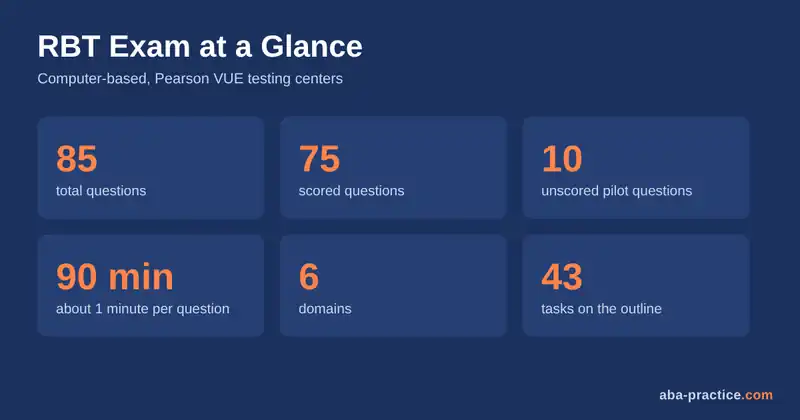
Every good RBT study plan starts with the exam’s blueprint, not a textbook. The BACB’s RBT Test Content Outline (3rd Edition) applies beginning in 2026, and it defines six domains and 43 tasks. The exam has 85 questions: 75 are scored and 10 are unscored pilot questions. You get 90 minutes, and the test is computer-based at Pearson VUE testing centers.
Do the math on that. Ninety minutes across 85 questions is about one minute per question. A slow, careful reader who spends two minutes on scenario questions will run out of clock. So your RBT study plan has to train speed as well as knowledge.
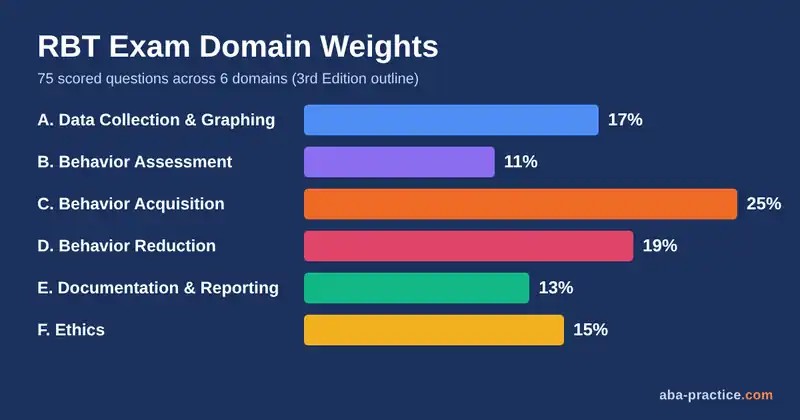
| Domain | Scored questions | Share of exam | Tasks |
|---|---|---|---|
| A. Data Collection and Graphing | 13 | 17% | 8 |
| B. Behavior Assessment | 8 | 11% | 3 |
| C. Behavior Acquisition | 19 | 25% | 11 |
| D. Behavior Reduction | 14 | 19% | 7 |
| E. Documentation and Reporting | 10 | 13% | 4 |
| F. Ethics | 11 | 15% | 10 |
| Our RBT bundle mirrors this weighting in its six domain modules and its 120-question mock exam. | |||
Two patterns jump out. Behavior Acquisition and Behavior Reduction together make up 44% of the exam. And Documentation plus Ethics add up to 28%, the same share as Data Collection and Behavior Assessment combined. Ethics has 10 tasks but only 11 questions, so it’s wide and shallow: lots of topics, few questions on each.
That shape drives the RBT study plan below. Acquisition gets five days, Reduction gets four, and Assessment gets two, because that’s roughly how the questions are distributed. Why would you give a 25% domain the same time as an 11% one?
The BACB doesn’t publish a numeric passing score. Its handbook says the passing standard is set with a modified Angoff method. So you can’t study toward “a 70” or “an 80.” You study toward being solid in every domain. You can read the official outline yourself in the BACB RBT Test Content Outline (3rd ed.).
Before Day 1: The Eligibility Checklist
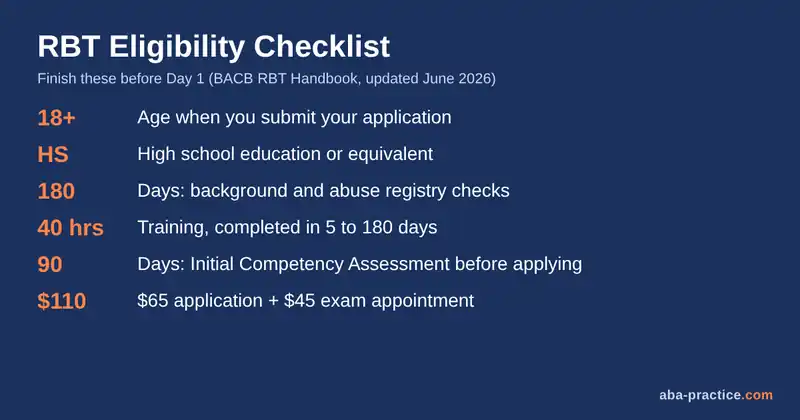
This part is boring, but skipping it can cost you months. A great RBT study plan does nothing if your application stalls. Here’s what the BACB’s RBT Handbook (updated June 2026) requires, in plain terms:
- You’re at least 18 when you submit the application, and you have at least a high school education or the equivalent.
- You’ve passed criminal background and abuse registry checks within 180 days of applying.
- You’ve completed the 40-hour training. It has to take no fewer than 5 days and no more than 180 days.
- You’ve completed the Initial Competency Assessment within the 90 days before you apply.
- You’ve paid the fees: $65 to process the application and $45 for the exam appointment, so $110 combined.
You don’t have to wait for approval to start studying. But remember the clock: the one-year testing window starts the day the BACB approves you, not the day you start Day 1. If your approval is three weeks away, start the plan so that Day 30 lands inside your window with room for a retake.
Not sure which resources fit your situation? The RBT exam prep page lays out every RBT guide and mock exam in one place, including the standalone RBT mock exam if you only want practice questions.
The 30-Day RBT Study Plan, Day by Day
Here’s the full RBT study plan map. We budget roughly 60 to 90 minutes a day. That pace is our suggestion, not a BACB rule, and you can stretch the plan if your schedule is tighter. The order matters more than the exact minutes: measurement first, because every other domain depends on reading data.
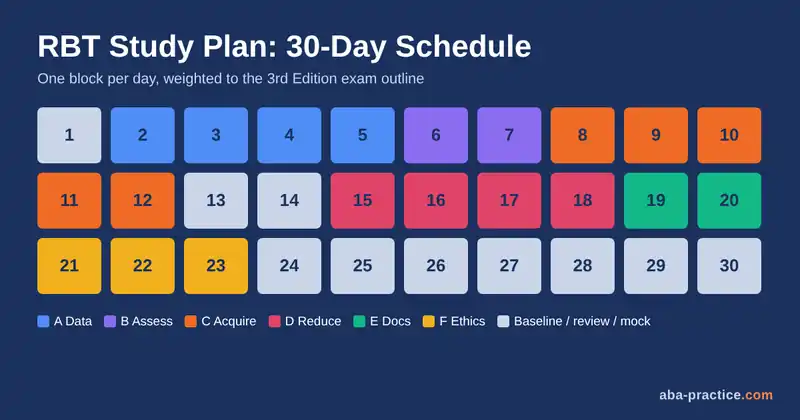
| Days | Focus | Exam weight |
|---|---|---|
| 1 | Baseline exam and outline review | All domains |
| 2 to 5 | Domain A: Data Collection and Graphing | 17% |
| 6 to 7 | Domain B: Behavior Assessment | 11% |
| 8 to 12 | Domain C: Behavior Acquisition | 25% |
| 13 to 14 | Mid-point check, then light review | A to C |
| 15 to 18 | Domain D: Behavior Reduction | 19% |
| 19 to 20 | Domain E: Documentation and Reporting | 13% |
| 21 to 23 | Domain F: Ethics | 15% |
| 24 to 30 | Weak spots, timed mock exam, review, logistics | All domains |
| Each day of this RBT study plan has a matching lesson in the RBT Study Guide & Mock Exam Bundle. | ||
RBT Study Plan Week 1 (Days 1 to 7): Baseline, Data and Assessment
Day 1. Take the free practice exam cold, before you study anything. A low score is fine. You’re collecting a baseline, and you’ll compare it to your Day 27 retake. Then skim the official outline once so you recognize the six domain names. Write down which domain felt worst.
Days 2 to 5: Domain A. The outline lists eight tasks here. They cover continuous measurement (frequency, duration, latency, interresponse time), discontinuous measurement (partial and whole interval, momentary time sampling), permanent product recording, entering data and updating graphs, describing behavior in observable and measurable terms, calculating summaries like rate and percentage, identifying trends, and the risks of unreliable data. Don’t just read these. Calculate a rate and a percentage by hand every day, because the exam asks you to apply formulas under time pressure.
Days 6 to 7: Domain B. Only three tasks, but they’re easy to blur together: preference assessments (multiple stimulus, paired stimulus, free operant), skill strength and deficit assessments, and the pieces of functional assessment such as descriptive assessment and functional analysis. Make a one-line comparison for each preference assessment method and quiz yourself on it tomorrow morning.
RBT Study Plan Week 2 (Days 8 to 14): Behavior Acquisition
This is the biggest domain, so it gets the biggest block. Eleven tasks across five days means grouping them by theme:
- Day 8: positive and negative reinforcement, and conditioned reinforcers (C.1, C.2).
- Day 9: discrete-trial teaching and naturalistic teaching (C.3, C.4).
- Day 10: task-analyzed chaining and shaping (C.5, C.10).
- Day 11: discrimination training, plus prompts and fading (C.6, C.7).
- Day 12: generalization, maintenance versus acquisition, and token economies (C.8, C.9, C.11).
On Day 13, run a mixed quiz covering Domains A, B and C only. Whatever you miss goes on a “fix list.” Day 14 is a light day: review the fix list, nothing new. Rest is part of an effective RBT study plan, and skipping it is how people burn out by Week 3.
If your quiz results feel shaky, don’t panic and don’t add days. Use the bundle’s domain analytics to see which domain dragged you down, then spend extra minutes there during the final week.
RBT Study Plan Week 3 (Days 15 to 23): Reduction, Documentation and Ethics
Days 15 to 18: Domain D. Seven tasks over four days. Day 15 covers common functions of behavior and antecedent interventions (NCR, high-probability request sequences, demand fading). Day 16 is differential reinforcement (DRO, DRA, DRI, DRL, FCT). Day 17 covers extinction and the secondary effects of extinction and punishment. Day 18 covers positive and negative punishment (such as time-out) and crisis or emergency procedures. The hard part here is telling the DR variants apart, so write each one’s definition in your own words.
Days 19 to 20: Domain E. Four tasks, all about communication: raising concerns with your supervisor, seeking clinical direction in a timely way, reporting variables that might affect client progress, and describing what happened in a session objectively. Practice by rewriting a subjective note (“he was angry”) into an objective one (“he cried for 3 minutes and pushed the materials off the table”).
Days 21 to 23: Domain F. Ten ethics tasks over three days. Day 21: the ethics code for RBT certificants, practicing only with demonstrated competence, and working under ongoing supervision. Day 22: effective supervision, confidentiality, public statements and multiple relationships. Day 23: gifts, professional skills when you represent yourself as an RBT, and cultural humility. Ethics questions usually describe a situation and ask what you should do. Practice with scenarios, not definitions.
RBT Study Plan Final Stretch (Days 24 to 30): Weak Spots, Mock Exam, Review
- Day 24: Re-study your two weakest domains. Use your fix list, not the whole domain.
- Day 25: Take a full timed mock exam. Aim for about one minute per question, the same pace the real 90-minute exam demands. The bundle’s 120-question mock works well for this.
- Day 26: Read every rationale, including the questions you got right. Right answers for the wrong reason are a trap.
- Day 27: Retake the free practice exam and compare it to your Day 1 baseline.
- Day 28: Light review of Domains E and F. These are the easiest points to protect.
- Day 29: Logistics only. Confirm your appointment, ID and route, then stop studying early.
- Day 30: A short skim, or exam day if your appointment lines up.
How to Run Each Study Day
A study schedule is only a calendar. What makes an RBT study plan work is the routine inside each day, and the same routine fits every domain. Use this loop on every day of your RBT study plan from Day 2 onward:
- Warm up (10 minutes). Without notes, write down everything you remember from yesterday’s tasks. Check what you missed.
- Learn (25 to 35 minutes). Read or watch the day’s tasks, then explain each one out loud as if you’re teaching a new technician.
- Apply (20 to 30 minutes). Work practice questions on today’s tasks only. Mark any you guess on.
- Check rationales (10 minutes). Read why every wrong option is wrong. This is where the learning happens.
- Update your fix list (5 minutes). One line per missed concept. This list feeds Day 13 and Day 24.
- Stop. Don’t extend the session. Consistency beats one heroic six-hour Saturday.
On a workday, split it in two: the warm-up and learning steps at lunch, the practice and rationales at night. Either way, the loop is the part of the RBT study plan you shouldn’t skip. If you’re studying alone, it does the job a tutor would. Retrieval at the start of each session is the habit that separates people who feel prepared from people who are prepared. You can feel confident after re-reading a chapter and still blank on a question about it.
Where a 30-Day RBT Study Plan Breaks Down
We’d rather tell you now than have you find out on Day 19. Three things sink most 30-day plans, and none of them is a lack of intelligence.
Treating every domain equally. A flat schedule gives Domain B the same time as Domain C even though C carries more than twice the weight (25% versus 11%). Follow the weights.
Studying passively. Highlighting and re-reading feel productive and test nothing. If you can’t answer a scenario question without the page open, you haven’t learned it yet. Our guide to first-time exam mistakes covers this pattern across credentials.
Ignoring the clock. Knowing the material and finishing on time are two separate skills. The Day 25 timed mock exists so you feel the pace before the real thing. Take it seriously: phone away, one sitting, no pausing.
One more honest note. A study plan can’t replace supervision or real session experience. RBT is a paraprofessional certification that works under ongoing supervision, and some exam scenarios will feel easier if you’ve already run sessions. If you haven’t, lean harder on the visual examples in Domains C and D.
Ready to start Day 1?
Take the free practice exam for your baseline, then run your RBT study plan with the RBT Study Guide & Mock Exam Bundle: six visual domain modules, a 120-question mock exam with full rationales, and domain analytics. $57 today, regular price $71. Instant digital access.
If You Live Outside the US, Canada and Australia
The BACB’s handbook says it currently accepts RBT applications from residents of the United States, Canada and Australia. It also says Ontario residents can no longer apply for RBT certification, and Australian residents lose eligibility on January 1, 2027. Existing certificants can keep their certification wherever they live.
Don’t let this RBT study plan push you toward a credential you can’t hold. The point of any RBT study plan is a certification you’re actually eligible for. So check first. It takes five minutes:
- Open the Jurisdiction section of the current RBT Handbook.
- Compare it with the country and province or state where you live.
- If you’re not on the list, don’t start this RBT study plan yet. Decide which credential is open to you first.
Jurisdiction rules have changed before. Re-check the handbook the week you apply, not just the week you start your RBT study plan.
If that rules you out, an entry-level credential from another board may fit. Our ABAT vs RBT comparison explains how the two differ, and the shop lists prep bundles for each. Planning to move up later? The BCBA exam prep guide shows what comes next.
Frequently Asked Questions
How long should an RBT study plan be?
The 30-day length in this guide is our design, not a BACB requirement. It works if you’ve already finished the 40-hour training and can give 60 to 90 minutes a day. If you have less time, stretch this RBT study plan over six weeks and keep the domain order.
How many questions are on the RBT exam?
The exam has 85 questions: 75 scored and 10 unscored pilot questions. You have 90 minutes, and it’s computer-based at Pearson VUE testing centers.
What is the passing score for the RBT exam?
The BACB’s handbook says the passing standard is set with a modified Angoff method and doesn’t list a number. Aim to be solid in every domain instead of chasing a score.
How many times can I retake the RBT exam?
You may test a maximum of 8 total attempts within 12 months after your initial application is approved. Plan your first attempt early in that window so you have room to adjust.
Which RBT domains matter most?
Behavior Acquisition is 25% of the exam and Behavior Reduction is 19%, so together they’re 44%. Data Collection and Graphing is 17%, Ethics is 15%, Documentation and Reporting is 13%, and Behavior Assessment is 11%.
Can I become an RBT from outside the US?
Only if you reside in the United States, Canada or Australia, and Australian residents lose that eligibility on January 1, 2027. Ontario residents can no longer apply. Check the current RBT Handbook before you apply, because jurisdiction rules have changed more than once.
Is this RBT study plan enough to pass?
No plan can guarantee a pass. This RBT study plan covers all six domains in proportion to their weight and builds in a timed mock exam, but your result also depends on your training, your supervised experience and how honestly you work through the rationales.
Where should I start, and where can I buy the bundle?
Start with the free practice exam to find your weak domains. When you’re ready to follow this RBT study plan with a full guide and mock exam, get the RBT Study Guide & Mock Exam Bundle.
Disclaimer: ABA Practice is an independent study resource and isn’t affiliated with or endorsed by the BACB. Practice questions are original study aids, not real exam items. Requirements, fees and eligibility rules change, so confirm the current details in the BACB’s RBT Handbook before you apply.