BCBA Exam Prep 2026: The Complete Guide to Avoid Costly Mistakes
Here’s what nobody tells you before you start BCBA exam prep: about 6 in 10 first-time candidates fail parts of the eligibility process before they even reach the exam room, not because the material is impossible, but because the BACB’s rules are scattered across a handbook, three newsletters, and a website that changes every few months. You can lose months chasing the wrong fieldwork pathway or the wrong coursework track.
This guide puts every current 2026 requirement in one place: the degree, the 315 coursework hours, the fieldwork hours, the exam itself, the fees, and the 2027 changes that are already reshaping who gets certified. If you want to skip the guesswork and jump straight into structured practice, the free BCBA practice exam is a fast way to see where you actually stand before you spend a dollar.
⚠️ Important: Since January 1, 2023, the BACB has stopped accepting new BCBA, BCaBA, and RBT applications from residents of most countries outside the US and Canada. A handful of countries kept temporary windows, and those are closing on a rolling basis (the UK’s ended January 1, 2026). If you live outside an approved country, standard BCBA exam prep may not lead anywhere — see the section below on what to do instead.
✅ If you live in the US, Canada, or an eligible country: You’re on the standard track. Everything in this guide applies to you directly, and the BCBA Bundle ($97) gives you a full mock exam, flashcards, and answer explanations built around the current 6th edition Test Content Outline.
🌍 If you live outside an approved country: New BCBA applications aren’t an option for you right now. Most candidates in this position pursue the IBA credential instead, and BCBA/QBA holders can often add it for as little as $99 through the IBA Addition pathway. It’s worth reading before you invest a single hour in BCBA exam prep.
What the BCBA Actually Requires (Quick Overview)
The Board Certified Behavior Analyst (BCBA) credential is the graduate-level certification that lets you practice independently and supervise RBTs and BCaBAs. It’s issued by the Behavior Analyst Certification Board (BACB), a US-based organization, and it’s the single most requested credential in ABA job postings. That’s exactly why BCBA exam prep is worth doing right the first time — a failed attempt costs you a $140 retake application plus a new $125 Pearson VUE fee, and most people who fail once weren’t actually behind on content. They were behind on structure.
| Requirement | What It Means | Where to Prep |
|---|---|---|
| Education | Master’s or higher in behavior analysis or a related field, accredited institution | — |
| Coursework | 315 hours of graduate-level, BACB-aligned coursework (Verified Course Sequence) | — |
| Fieldwork | 1,500 hours (concentrated) or 2,000 hours (supervised) | — |
| Exam | Multiple-choice, 4 hours, based on the 6th edition Test Content Outline | BCBA Bundle — $97 |
| International alternative | Not in an eligible country | IBA Kit — $67 |
Education and the 315-Hour Coursework Requirement
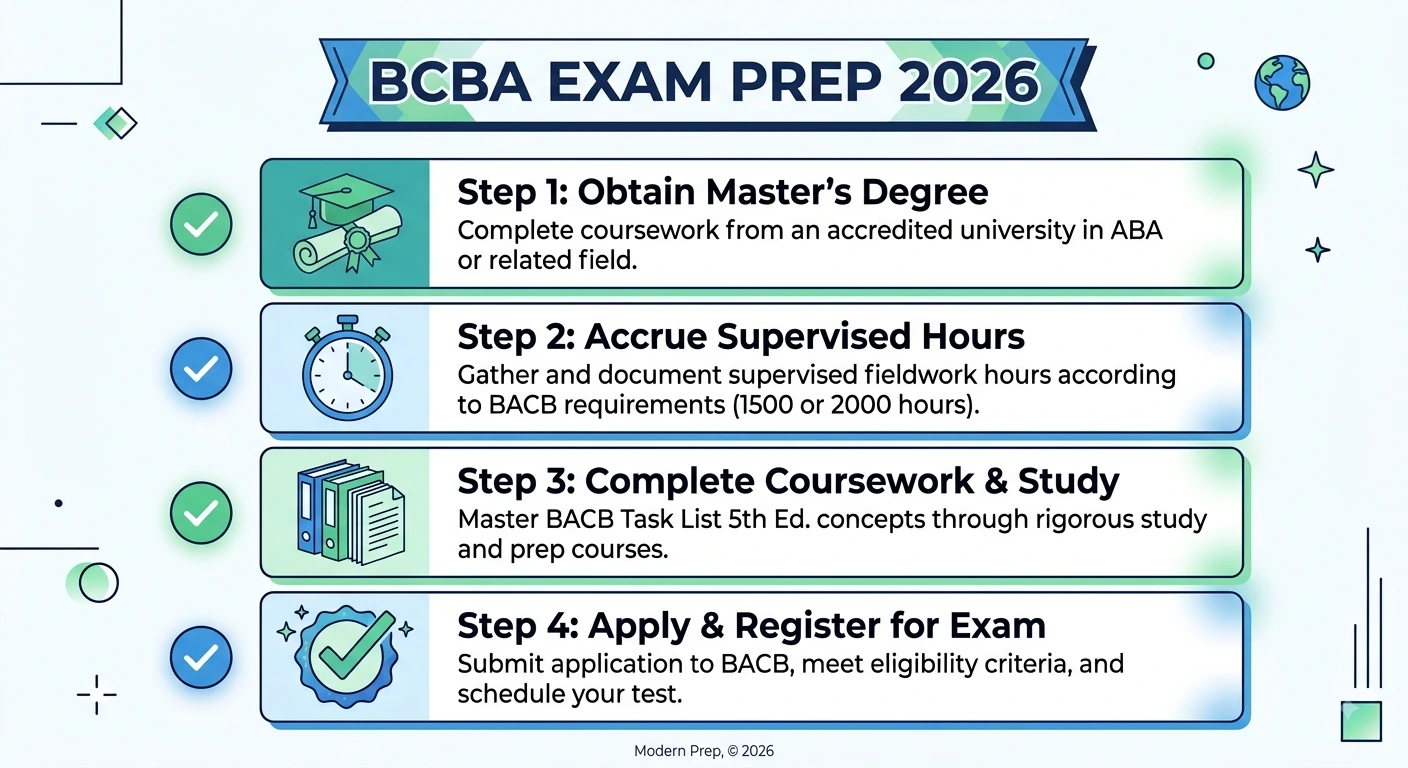
You need a master’s degree or higher, in behavior analysis or a closely related field, from an accredited institution. The degree itself can be old. What matters more is the coursework layered on top of it.
The BACB requires 315 hours of graduate-level, behavior-analytic coursework covering six content areas: ethics, measurement and data collection, experimental design, behavior-change procedures, ethical decision making, and supervision. Most candidates complete this through a Verified Course Sequence (VCS) — either built into their graduate program or added as a standalone certificate afterward. About 40 to 50 ABAI-accredited programs in the US have this baked in already, which is the cleanest route if you’re still choosing a program.
If your degree program didn’t include a VCS, you’ll need to find one separately before you can move forward with BCBA exam prep. Don’t skip this step to “save time.” Incomplete coursework is one of the most common reasons applications get sent back for correction.
Fieldwork Hours: 1,500 vs 2,000
This is where most candidates lose momentum. You have two paths:
- Concentrated fieldwork: 1,500 hours, done at a higher weekly intensity under closer supervision.
- Standard supervised fieldwork: 2,000 hours, spread out with a lower minimum supervision percentage.
Both must be completed under a qualified BACB supervisor, and both require monthly documentation using the current fieldwork forms. Here’s the honest part: a lot of candidates pick 2,000 hours because it sounds “safer,” then burn out halfway through because it drags on for over a year longer than they expected. Talk to your supervisor about your actual schedule before you commit to a track, not after.
The BCBA Exam: What’s Actually on the 6th Edition Test Content Outline
Once your application is approved, you’ll get an Authorization to Test and a window to schedule at a Pearson VUE center. You’ll have four hours to work through multiple-choice questions pulled from the current BCBA Test Content Outline (6th edition), which has been in effect since January 1, 2025. The content spans measurement and data collection, experimental design, behavior-change procedures, functional assessment, ethical decision making, reinforcement schedules, stimulus control, generalization, and maintenance.
Ethics alone accounts for a large share of the exam, and it’s the section that trips up candidates who spent all their study time on procedures and none on the code itself. A BCBA mock exam that mirrors the real question style — not just flashcards of definitions — is what actually catches these gaps before test day.
Total cost for the application and exam is $370: a $245 application fee to the BACB, plus a $125 exam appointment fee paid directly to Pearson VUE. If you don’t pass, retakes require a $140 BACB retake application and a fresh $125 Pearson VUE fee, with a required waiting period between attempts.
The Geographic Restriction, Explained Properly
Remember the alert box at the top of this guide? Here’s the full picture. As of January 1, 2023, the BACB stopped accepting new BCBA, BCaBA, and RBT applications from people living outside the US and Canada. A short list of other countries kept a temporary window — the UK’s closed on January 1, 2026, and others are on their own sunset timelines. If your country isn’t on the current approved list, no amount of studying changes your eligibility. That’s not a preparation problem. It’s a jurisdiction problem.
This is exactly why the IBA (International Behavior Analyst) credential exists as a parallel pathway, and why it matters if you already hold a BCBA or QBA: many holders can add IBA credentials for as little as $99 through the Addition pathway, which extends your ability to practice and supervise in countries where the BCBA itself isn’t issued anymore. If this applies to you, read our full QBA vs BCBA vs IBA comparison before committing to a study track.
What’s Changing by 2027 (and Why It Matters Now)
The BACB doesn’t announce changes quietly, but they do bury them in newsletters most candidates never read. Two changes matter most if you’re starting BCBA exam prep in 2026:
Starting January 1, 2027, Pathways 3 and 4 (the faculty and postdoctoral routes) are being discontinued for new applicants. If you were planning to qualify through a teaching or postdoc position, you need to apply before that date or shift to the standard coursework-and-fieldwork route. Pathway 2 is also being phased down on a longer timeline, with Pathway 1 (the ABAI/APBA-accredited program route) set to become the only option by 2032.
None of this affects your exam content directly. It affects which door you’re allowed to walk through to get there. If you’re early in your degree, this is worth a conversation with your program advisor now, not after you’ve built a fieldwork plan around a pathway that’s about to close.
Where BCBA Fits Next to QBA and RBT
If you’re comparing credentials before committing to a track, it helps to see them side by side rather than guess. The RBT sits at entry level, with a shorter exam and no degree requirement. The QBA sits in the middle, often used as an alternative behavior analysis certification where BCBA eligibility isn’t available or where a candidate’s background doesn’t fit the BCBA degree pathway. BCBA sits at the top: graduate-level, independent practice, and the credential most job postings name specifically.
None of these are strict upgrades of each other. QASP-S candidates supervise autism services rather than general ABA cases, and ABAT sits below RBT in some regions as a technician-level entry point. If you’re still deciding which certification actually fits your background and location, our QBA vs BCBA vs IBA comparison breaks down eligibility, cost, and recognition for each one in more depth than this guide can cover.
One more thing worth saying plainly: your supervisor matters as much as your coursework. The BACB requires supervisors to complete their own supervision training and to document their percentage of contact hours correctly. If you’re choosing between two potential supervisors, ask each one how many current supervisees they have and how they structure feedback. A supervisor stretched across a dozen fieldwork candidates isn’t going to catch small errors before they become application problems.
How to Actually Start: A 7-Step BCBA Exam Prep Plan
- Confirm your eligibility country. If you’re outside the US or Canada, check the current approved list before doing anything else, and look at the IBA alternative if you’re not covered.
- Verify your degree meets the requirement. Master’s or higher, behavior analysis or a related field, accredited institution.
- Complete or confirm your 315-hour VCS coursework. Get written confirmation from your program, not just an assumption it’s included.
- Choose your fieldwork track. 1,500 concentrated or 2,000 supervised, based on your real weekly availability, not the “faster-sounding” option.
- Submit your application and pay the $245 fee. Double-check every form; incomplete submissions trigger extra processing fees and delays.
- Start structured review at least 8-10 weeks out. Use timed practice sets, not just flashcards, so the four-hour format doesn’t blindside you. The BCBA Bundle gives you instant access to a full mock exam and explanations built around the current outline.
- Schedule your Pearson VUE exam once your Authorization to Test arrives, and leave buffer time before your window closes.
BCBA Salary and Job Demand in 2026
The financial case for finishing certification is straightforward. The average US BCBA salary sits around $102,000, with clinical supervisor and director roles pushing well past that. Demand has grown faster than the supply of certified practitioners for years running, and job postings requiring BCBA or broader behavior analyst certification have climbed steadily across California, Texas, New Jersey, Massachusetts, and North Carolina.
That demand is part of why the geographic restriction stings so much for candidates outside the US and Canada. Employers in those states are actively hiring, but a new BCBA application from someone living abroad simply isn’t an option under current BACB rules. If that’s your situation, the IBA pathway covered earlier is worth serious consideration before you sink a year into a degree track that won’t lead to eligibility.
Common Mistakes That Delay a BCBA Application
Most delays aren’t about intelligence or effort. They’re about process. Here are the mistakes that show up again and again:
Assuming coursework “probably” counts. Graduate programs advertise behavior-analysis tracks all the time, but not every one includes a full 315-hour Verified Course Sequence. Get it in writing from your program before you build a timeline around it.
Picking a fieldwork track based on the label, not the math. “Concentrated” sounds harder, so some candidates default to the 2,000-hour standard track without checking their actual weekly availability. Do the math on your real schedule first.
Under-documenting supervision. Monthly fieldwork forms need signatures, hour breakdowns, and supervision percentages that match BACB requirements exactly. A missing signature can bounce an application back weeks later.
Treating the exam like a vocabulary test. Definitions matter, but the BCBA exam leans heavily on applied scenarios. Reading a glossary is not the same as working through timed practice questions that mirror the actual format.
What BCBA Certification Actually Costs
| Item | Cost |
|---|---|
| BACB application fee | $245 |
| Pearson VUE exam appointment | $125 |
| Retake application (if needed) | $140 + $125 exam fee |
| Graduate coursework / VCS | Varies by program, often $15,000-$40,000+ |
| BCBA Bundle mock exam + flashcards | $97 |
The degree and coursework are the real expense. The $370 application-and-exam total is small by comparison, which is exactly why it’s worth protecting with solid BCBA exam prep instead of gambling on a retake.
Ready to start real BCBA exam prep?
The BCBA Bundle gives you a full timed mock exam, flashcards, and answer explanations mapped to the current 6th edition outline — instant access, no waiting on shipping. If you’re not sure it’s the right fit yet, try the free practice exam first.
Frequently Asked Questions
How long does BCBA certification take from start to finish?
Most candidates need 3-4 years after starting graduate coursework, or 6-8 years total including undergraduate study. Fieldwork alone typically takes 12-24 months depending on which track you choose.
Can I do BCBA exam prep while still completing fieldwork hours?
Yes, and it’s a smart move. Reviewing content while you’re actively applying it in fieldwork tends to stick better than cramming after you’ve already logged your hours.
What’s the difference between BCBA and BCBA-D?
BCBA-D is a doctoral-level designation available only to candidates who already hold active BCBA certification. It’s not a separate exam path.
Is the BCBA exam harder than the QBA or RBT exams?
Yes. The BCBA exam covers graduate-level content across nine domains in a four-hour window, compared to the shorter, narrower RBT exam. QBA sits in between, depending on your background.
What happens if I fail the BCBA exam?
You can retake it after a required waiting period, for a $140 retake application plus a new $125 Pearson VUE fee. You get up to eight attempts within a two-year authorization window.
Does a BCBA mock exam actually predict my real score?
Not perfectly, but a well-built one gets close. The value isn’t the raw score — it’s seeing which of the nine content domains you’re weakest in while you still have time to fix it.
Do I need a BCBA study guide, or is the handbook enough?
The handbook tells you the rules. It doesn’t simulate the exam. A BCBA study guide with timed practice questions and explanations is what actually builds exam-day stamina and catches content gaps early.
I live outside the US and Canada. Can I still become a BCBA?
Not through a new application, as of the current BACB rules. Look into the IBA credential instead, especially the low-cost IBA Addition pathway if you already hold a BCBA or QBA.
Where should I start my BCBA exam prep today?
Start with the free practice exam to see where your gaps actually are, then move into the full BCBA Bundle for timed mock exams, flashcards, and answer explanations built around the current outline.
Disclaimer: ABA Practice is an independent exam-prep resource and is not affiliated with, endorsed by, or acting on behalf of the Behavior Analyst Certification Board (BACB), QABA, or IBAO. Certification requirements, fees, and eligibility rules change; always confirm current details directly with the BACB before applying.
Sources: