
You can know every definition on the RBT task list and still miss RBT scenario questions. That’s because scenario questions don’t ask what a term means. They ask what you’d do, right now, with a real client in front of you. Before you read the method below, take the free ABA practice exam so you have an honest baseline to compare against.
One rule first. The BACB currently accepts RBT applications only from residents of the United States, Canada and Australia, and Australian residents lose that eligibility on January 1, 2027. If you live somewhere else, jump to the ABAT option before you spend time on RBT scenario questions.
⚠️ Important: The 5 RBT scenario questions in this guide are original practice items we wrote from the BACB’s published task list. They aren’t real exam items, and we made them harder than an average question on purpose. Missing two or three of them doesn’t predict your exam result. It shows you where to study.
✅ If you live in the US, Canada or Australia: Work through the five questions below, then practice the full blueprint with the RBT Study Guide & Mock Exam Bundle. It’s $57 right now (regular price $71).
🌍 If you live anywhere else: RBT isn’t open to you right now. The ABAT practice questions cover a credential you can actually apply for.
Table of Contents
- Why RBT Scenario Questions Trip People Up
- The 4-Step Method for RBT Scenario Questions
- The 4 Distractor Types to Spot
- 5 RBT Scenario Questions to Try
- How Did You Do?
- A Daily Routine for Scenario Practice
- If You Live Outside the US, Canada and Australia
- Frequently Asked Questions
Why RBT Scenario Questions Trip People Up
The RBT exam has 85 questions: 75 scored and 10 unscored pilot questions. You get 90 minutes at a Pearson VUE testing center. That’s roughly one minute per question. A definition question takes ten seconds. RBT scenario questions can eat two minutes each if you don’t have a system.
The BACB’s RBT Test Content Outline (3rd Edition), which applies beginning in 2026, lists 43 tasks across six domains. Read the task wording closely and you’ll notice the verbs: implement, conduct, communicate, report, identify and apply. Those are action verbs. The outline is telling you the exam cares about what you do on the job, and RBT scenario questions are how it tests that.
Here’s the honest part. Most wrong answers on RBT scenario questions aren’t caused by missing knowledge. They’re caused by picking an answer that’s reasonable but isn’t the best fit for the exact situation, or that belongs to your supervisor’s job instead of yours. Both mistakes are fixable with a method.
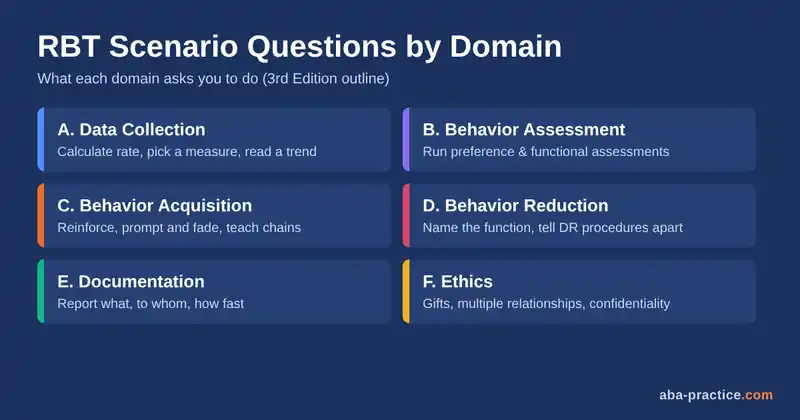
Every domain can show up as a scenario, but the style changes. This table shows what RBT scenario questions usually look like in each domain, based on the task wording in the official outline:
| Domain (scored questions, share) | What the scenario asks you to do |
|---|---|
| A. Data Collection and Graphing (13, 17%) | Pick a measurement method, calculate rate or percentage, read a trend |
| B. Behavior Assessment (8, 11%) | Choose or run a preference assessment, take part in functional assessment |
| C. Behavior Acquisition (19, 25%) | Deliver reinforcement, run prompts and fading, teach chains and discriminations |
| D. Behavior Reduction (14, 19%) | Name the function, tell DR procedures apart, expect extinction effects |
| E. Documentation and Reporting (10, 13%) | Decide what to report, to whom and how fast, in objective terms |
| F. Ethics (11, 15%) | Handle gifts, multiple relationships, confidentiality and scope |
| Practice all six domains with full rationales in the RBT bundle’s 120-question mock exam. | |
The 4-Step Method for RBT Scenario Questions
Use the same four steps on all RBT scenario questions. It feels slow at first. After a few dozen reps it becomes quick, and it stops you from falling for the answer that only sounds right.
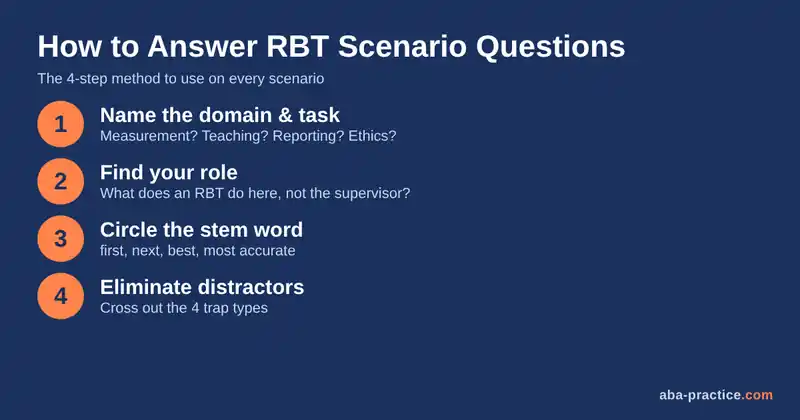
- Name the domain and task. Before you read the options, ask: is this measurement, teaching, reduction, reporting or ethics? Naming the task narrows the right answer to one family of procedures. If you can’t name it, that’s a study gap, so note it.
- Find your role. Ask what an RBT does here, not what a behavior analyst would do. The RBT Ethics Code says RBTs work “within a clearly defined role under close, ongoing supervision.” Any option where you change the plan, give medical advice or make a clinical decision alone is almost always wrong.
- Circle the stem word. Look for words like first, next, best, most accurate or most likely. “What should you do first” and “What’s the best long-term fix” have different answers for the same story.
- Eliminate by distractor type. Cross out options that match one of the four distractor types below. You’ll usually get down to two choices fast, and then the stem word decides.
Want to see the method used against a full timed set? The standalone RBT mock exam is built for exactly that kind of practice.
The 4 Distractor Types Hiding in RBT Scenario Questions
In RBT scenario questions, a distractor is a wrong option written to look right. Good RBT scenario questions use the same few patterns over and over. Once you can name them, they lose most of their pull.
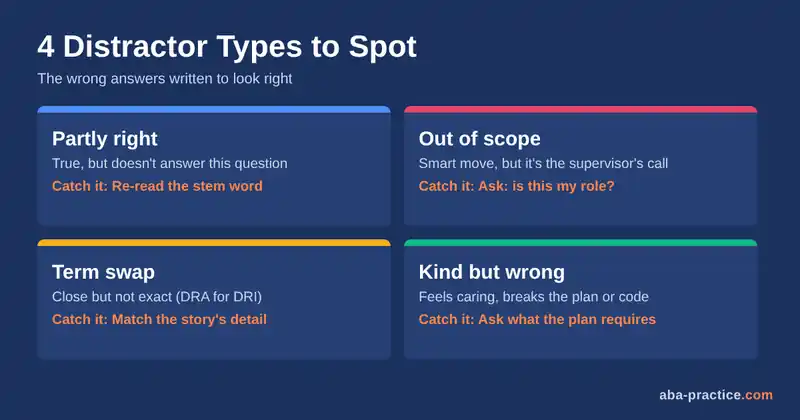
| Distractor type | What it looks like | How to catch it |
|---|---|---|
| Partly right | True statement that doesn’t answer this question | Re-read the stem word |
| Out of scope | A smart move, but it’s the supervisor’s call | Ask “Is this my role?” |
| Term swap | A procedure that’s close but not exact (DRA for DRI) | Match the detail in the story to the definition |
| Kind but wrong | Feels caring or helpful, breaks the procedure or the code | Ask what the plan or code requires |
| The mock exam in the RBT Study Guide & Mock Exam Bundle includes rationales, so you can see which trap caught you. | ||
The “kind but wrong” type is the sneakiest. It works because RBTs are caring people. These options feel warm, like accepting a gift from a grateful family or giving a tired client an easier session. On RBT scenario questions, the right answer is the one that follows the plan and the code, even when it feels less friendly.
5 RBT Scenario Questions to Try
Answer each one before you open the explanation. Time yourself: aim for about a minute per question, the same pace as the real exam. Write down your answers so you can score yourself honestly at the end. These RBT scenario questions get harder as you go.
Question 1 (Domain A, moderate)
On Monday, an RBT records 10 instances of a client’s requests (mands) during a 20-minute session. On Wednesday, the session runs 40 minutes, and the RBT records 12 instances. The supervisor asks for a summary of the change. Which statement is most accurate?
- A. Requesting increased, because 12 is more than 10.
- B. The sessions can’t be compared because they were different lengths.
- C. Requesting decreased, from 0.5 to 0.3 responses per minute.
- D. Requesting stayed about the same, at roughly 11 per session.
Show answer and explanation
Correct answer: C. Rate equals count divided by time. Monday: 10 ÷ 20 = 0.5 per minute. Wednesday: 12 ÷ 40 = 0.3 per minute. That’s a decrease, even though the raw count went up. This matches task A.6, “Calculate and summarize data in different ways (e.g., rate, mean duration, percentage).”
Why A is wrong: It compares raw counts across sessions of different lengths. That’s the classic term-swap trap: count instead of rate.
Why B is wrong: It’s partly right. Raw counts can’t be compared here. But rate exists exactly so you can compare sessions of different lengths.
Why D is wrong: Averaging the two counts hides the change and still ignores time.
Question 2 (Domain C, moderate)
Your supervisor’s plan uses least-to-most prompting to teach a client to put on a jacket. You give the instruction “Put on your jacket” and wait the time listed in the plan. The client doesn’t respond. What should you do next?
- A. Use full physical guidance so the client completes the step without errors.
- B. Deliver the least intrusive prompt in the plan’s hierarchy, such as a gesture toward the jacket.
- C. Repeat “Put on your jacket” two or three more times until the client responds.
- D. Skip the jacket today and record the step as not attempted.
Show answer and explanation
Correct answer: B. Least-to-most prompting starts with the least intrusive prompt and moves up the hierarchy only when the client still doesn’t respond. Follow the order written in your plan. This is task C.7, which covers prompts and fading, including least-to-most.
Why A is wrong: Full physical guidance first describes a different procedure (most-to-least or errorless teaching). It’s a term-swap distractor, and it’s not what this plan says.
Why C is wrong: Repeating the instruction isn’t a step in a prompt hierarchy. It can teach the client to wait for the third request.
Why D is wrong: It feels gentle, but skipping the target isn’t in the plan. That’s the “kind but wrong” trap.
Question 3 (Domain D, hard)
A client flaps her hands during group circle time. Her behavior plan tells the RBT to deliver praise and a token whenever she holds a fidget ball with both hands. Which procedure is the RBT implementing?
- A. Noncontingent reinforcement (NCR)
- B. Differential reinforcement of other behavior (DRO)
- C. Differential reinforcement of alternative behavior (DRA)
- D. Differential reinforcement of incompatible behavior (DRI)
Show answer and explanation
Correct answer: D. The clue is “with both hands.” She can’t hold a ball with both hands and flap her hands at the same time. Reinforcing a behavior that physically can’t occur alongside the problem behavior is DRI. Task D.3 lists DRO, DRA, DRI, DRL and FCT, so expect questions that make you tell them apart.
Why C is the trap: DRA reinforces an alternative behavior, and holding the ball is an alternative. But DRI is the more precise answer because the behavior is incompatible. When two options both fit, the stem word “which procedure” wants the most exact one.
Why B is wrong: DRO reinforces the absence of a behavior over an interval. Nothing in the story mentions an interval.
Why A is wrong: NCR delivers reinforcement on a time schedule regardless of behavior. Here the token depends on what she does.
Mixed up DRA and DRI? You’re not alone. It’s one of the most common term swaps in RBT scenario questions, and the bundle’s Behavior Reduction module covers the whole domain.
Question 4 (Domain E, hard)
At drop-off, a parent mentions that her son started a new medication yesterday. During your session he seems drowsy, and his correct responding is well below his usual level. What is the best action?
- A. Document what the parent said and what you observed in objective terms, and report it to your supervisor promptly.
- B. Lower his targets for the rest of the week so he can still earn reinforcement.
- C. Tell the parent the medication may be hurting his progress and suggest she ask the doctor about stopping it.
- D. Make a mental note and bring it up at your next scheduled supervision meeting.
Show answer and explanation
Correct answer: A. Task E.3 says to “Report/document variables that might affect client progress in a timely manner (e.g., illness, medication, schedule changes).” Medication is listed by name. Objective notes (“He closed his eyes for about 10 seconds three times”) help your supervisor more than labels like “tired.”
Why B is wrong: Changing targets is a clinical decision. It’s out of scope for an RBT.
Why C is wrong: Medical advice is far outside an RBT’s role, and it could put the client at risk.
Why D is wrong: It’s partly right, because it does involve the supervisor. But “next scheduled meeting” fails the “timely manner” part of the task.
Question 5 (Domain F, hardest)
A parent you’ve worked with for six months asks if you’d babysit her son, your client, on Saturday nights. She offers to pay above the going rate, and the work would be outside your agency hours. What should you do?
- A. Accept, because it’s outside work hours and isn’t part of ABA services.
- B. Accept, as long as you tell your supervisor about it first.
- C. Accept but refuse payment, so it’s a favor instead of a business arrangement.
- D. Politely decline, and let your supervisor know the offer was made.
Show answer and explanation
Correct answer: D. Babysitting your client creates a second relationship with the same family. Standard 1.10 of the RBT Ethics Code says “RBTs avoid multiple relationships with clients, coworkers, and supervisors,” and tells RBTs to immediately inform their supervisor if one develops. Telling your supervisor about the offer keeps them in the loop. This is task F.7.
Why B is the trap: Telling your supervisor is good, so this option feels safe. But it still has you accept, which creates the multiple relationship you’re supposed to avoid.
Why C is wrong: Doing it for free doesn’t remove the second relationship. It’s “kind but wrong.”
Why A is wrong: The code covers your relationship with the client, not just your working hours.
How Did You Do on These RBT Scenario Questions?
Count your correct answers. Then use this table to decide what to do next. Remember, these five RBT scenario questions were written to be harder than average, so treat the result as a study map, not a prediction.
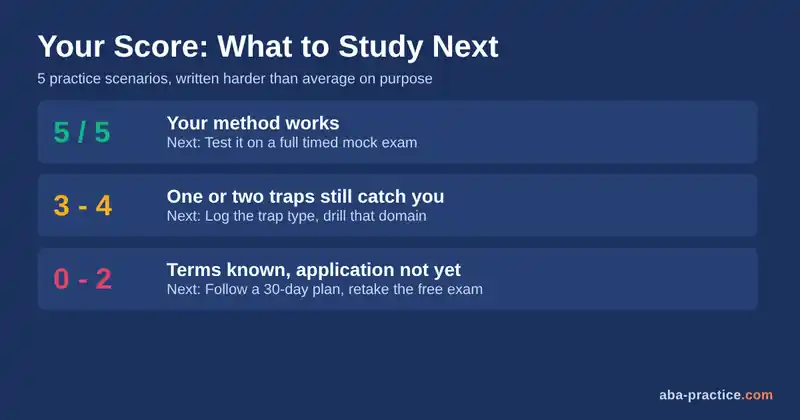
| Your score | What it suggests | Next step |
|---|---|---|
| 5 of 5 | Your method works on these domains | Test it under time across all 43 tasks with a full mock exam |
| 3 or 4 | Solid base, one or two trap types still catch you | Note which distractor type you fell for, then drill that domain |
| 0 to 2 | You likely know terms but not yet how they apply | Follow a structured 30-day RBT study plan and retake the free practice exam |
Look at which RBT scenario questions you missed, not just how many. Missing Question 1 points to Domain A math. Missing Question 4 or 5 usually means scope: you picked a reasonable action that wasn’t yours to take. That second pattern is common, and it’s the easiest one to fix.
A Daily Routine for RBT Scenario Questions
Five questions won’t build the skill. Repetition will. This routine takes about 30 minutes a day and works with any question source. Run it for two weeks and RBT scenario questions start to feel familiar.
- Do 10 RBT scenario questions untimed. For each one, write the domain letter and task number before you answer. If you can’t name the task, look it up in the official outline.
- Explain every wrong option. Out loud or on paper, say which distractor type it is. This is the step most people skip, and it’s the one that pays off.
- Keep a trap log. One line per miss: the question topic and the trap type. After a week, you’ll see your pattern.
- Do 10 more RBT scenario questions timed. One minute each. Speed matters, because 85 questions in 90 minutes leaves almost no slack.
- Review your log every Sunday. Re-study the domain behind your most common trap, then test it again.
Need scenarios to feed that routine? The other boards’ question sets on our site use the same format. The QBA practice questions and IBA practice questions are pitched higher than RBT, so use them only if you want an extra challenge.
And if your misses cluster around one habit, like rushing or second-guessing, our list of common first-time exam mistakes covers how to break it.
Ready for more RBT scenario questions?
Start with the free practice exam, then get the RBT Study Guide & Mock Exam Bundle: six domain modules, a 120-question mock exam with full rationales, and domain analytics that show where your points are leaking. $57 today, regular price $71.
If You Live Outside the US, Canada and Australia
The BACB’s RBT Handbook says it currently accepts RBT applications from residents of the United States, Canada and Australia. It also says Ontario residents can no longer apply, and Australian residents lose eligibility on January 1, 2027. People who already hold the credential can keep it wherever they live.
So check the Jurisdiction section of the current handbook before you invest weeks in RBT scenario questions. If your country isn’t on the list, the method in this guide still works on other entry-level exams. Read our ABAT vs RBT comparison to see which credential fits, then browse the shop for prep in that track.
Frequently Asked Questions
How many questions are on the RBT exam?
85 in total: 75 scored and 10 unscored pilot questions. You have 90 minutes, and the exam is computer-based at Pearson VUE testing centers.
Are all RBT exam questions scenarios?
The BACB doesn’t publish a split between scenario and definition questions. But the task list is written with action verbs like “implement” and “report,” so you should expect plenty of RBT scenario questions in every domain.
What’s the fastest way to get better at RBT scenario questions?
Name the task before reading the options, then ask whether each option is within your role. Those two habits remove most wrong answers. After that, volume plus honest review of your misses does the rest.
Which domain has the most questions?
Behavior Acquisition, with 19 scored questions (25%). Behavior Reduction is next with 14 (19%), then Data Collection and Graphing with 13 (17%).
Can an RBT accept a gift from a client’s family?
Only within the limit in the RBT Ethics Code. Standard 1.11 says RBTs don’t give or accept gifts with a monetary value of more than $10 US dollars. Check the full standard in the code for the details.
Are these the same questions as the real exam?
No. Every question here is an original practice item based on the published task list. Real exam items are confidential, and nobody outside the BACB should claim to have them.
Where can I practice more RBT scenario questions?
Take the free practice exam first to find your weak domains. When you want full-length practice with rationales, get the RBT Study Guide & Mock Exam Bundle.
Disclaimer: ABA Practice is an independent study resource and isn’t affiliated with or endorsed by the BACB. The practice questions in this article are original study aids, not real exam items. Exam details, fees and eligibility rules change, so confirm current information in the BACB’s official documents.